Tampilkan postingan dengan label ipod. Tampilkan semua postingan

Senin, 31 Oktober 2011

Siri hacked to work on iPhone 4 and iPod touch 4G

Siri has been made to work its personal electronic assistant magic on the iPhone 4 and iPo...
When Apple unveiled the iPhone 4S on October 4, Siri was seen as the new iDevice's biggest selling point and a major carrot to encourage iPhone 4 owners to upgrade. Although Siri originally appeared in the App Store in early 2010 before being acquired by Apple, the assumption was that the new version integrated into iOS 5 relied on the faster processor found in the iPhone 4S for Siri to work her voice recognition magic. Developer Steven Troughton-Smith and Grant Paul have proven that is not the case by not only getting Siri working on an iPhone 4, but also an iPod touch 4G.
Having previously succeeded in porting the Siri interface and some iPhone 4S code onto a jailbroken iPhone 4, Troughton-Smith and Paul have now managed to get the Siri port to communicate with Apple's servers to provide full Siri voice command functionality. The pair accomplished their feat by using software authentication tokens from a jailbroken iPhone 4S to trick Apple's servers into thinking an iPhone 4 and an iPod touch 4G were actually an iPhone 4S.
The only feature Troughton-Smith and Paul were unable to implement was the "raise to speak" feature that sees Siri activated when the phone is raised to your ear. This is apparently due to the fact that the feature relies on the new gyroscope found in the 4S.
In an interview with 9to5mac, Troughton-Smith says he has no plans to make Siri available for non-supported devices through the release of a specific jailbreak tool on Cydia or other jailbreak stores. While he admits others will likely do so, he is cautious of opening himself up to legal action by modifying and distributing files taken from an iPhone 4S. It won't stop him continuing his work, however, as he now plans to see whether he can make Siri run on an iPhone 3GS.
Whether this prompts Apple to make Siri available for devices other than the iPhone 4S remains to be seen. It can't make the argument that Siri requires the faster processor found in the 4S and Troughton-Smith and Paul aren't the only ones working on a way to get Siri onto unsupported devices.
In Apple's defense, Siri on the iPhone 4S is a beta release - sure, one that garnered a lot of attention and presumably played a part in the iPhone 4S being the company's most successful iPhone launch yet - but a beta release nonetheless. This means there's still a chance that Apple will bring some Siri love to owners of other devices once Siri has proven itself on the 4S. We'll just have to wait and see and hold our cynicism in check until then.

Selasa, 25 Oktober 2011

Apple iPod fathers create 'world's first learning thermostat'

At Apple (AAPL), Tony Fadell and Matt Rogers led teams that created the iPod and iPhone, displaying a knack for transforming the utilitarian and functional into sexy and desirable.
Now the two former Apple engineers hope to perform a similar alchemy with a device even more banal than a cellphone or music player -- that beige lump of plastic on the wall called a thermostat. After more than a year in an Apple-like shroud of secrecy, their Palo Alto startup, Nest, emerged from stealth Tuesday to announce a product that Fadell and Rogers hope will be so irresistibly cool that consumers will actually flock to save energy.
For starters, the $249 Nest Learning Thermostat isn't plastic, but a circular brushed stainless steel device, with a rotating outer control ring somewhat reminiscent of the iPod's control wheel. It's attractive and compelling to touch, and can connect to the Internet through a home Wi-Fi system, allowing it to be controlled by iPhone or Android smartphone apps.
The thermostat "learns" your household habits through a combination of sensors, machine learning, and cloud computing, meaning that if you typically get up at 7 a.m. and turn up the heat, before lowering it when you leave for work, the thermostat will soon learn to mimic that routine automatically.
What Nest says is the world's first "learning thermostat" has the onboard computing power of an iPhone. When users pick a setting that uses less energy, a green leaf icon pops up in the display -- a sort of reward for good energy behavior.
But what hooked Google (GOOG) Ventures, which provided funding along with venture capital giant Kleiner Perkins Caufield & Byers and Al Gore's Generation Investment Management, is that however humble and ugly, the thermostat is the epicenter of home energy consumption. About one-third of annual U.S. residential electrical consumption, and 86 percent of residential fuel oil use, is used for heating, according to the U.S. Energy Information Administration. An additional 21 percent of residential electricity use goes to cooling homes.
"If you could have one of these in every living room in America, you could save the U.S. 3 percent of its energy consumption, and that would be a profound impact," said Erik Charlton, Nest's chief of sales and marketing.
While programmable thermostats have been around since the 1970s, Nest's founders say no one has done anything revolutionary to improve them for decades.
Google Ventures managing partner Bill Maris remembers his dubious initial reaction to the idea of financing a thermostat. He's now on Nest's board.
"I thought, 'I like the team; I love Tony's background,' " Maris said. "Then you hear it's a new generation of thermostat, and I kind of became skeptical. I was like, 'What can we do here that's interesting?' But then when you see the product ... you touch it, you feel it, and you say, 'This is something new and I want that in my house.' "
Nest says its learning thermostat can cut home heating and cooling use by an average 30 percent over a standard thermostat.
Fadell, Nest's co-founder and CEO, was an adviser to Apple CEO Steve Jobs. Then Fadell quit Apple in early 2010, wanting to make a thermostat that would be beautiful as well as functional. As with Apple products, design was crucial.
"You can buy a beautiful refrigerator; you can buy a beautiful stove; you can buy a beautiful vacuum cleaner, but you can't buy a beautiful thermostat," Charlton said.
Nest started in a Palo Alto garage about 18 months ago, before quietly taking offices in a Palo Alto shopping center. Explaining Fadell's zest for secrecy -- Maris said he was forbidden from uttering the word "Nest" over the past year -- Charlton said, "We wanted a focus on the product and the team. Tony said, 'Let's not go out and talk to people; let's just build a great product.' "
At Apple, Fadell led the teams that developed the first generations of the iPod and iPhone, and is generally credited with the idea of linking a digital music player with an online music store -- the concept that became Apple's iPod and iTunes. Rogers, Nest's other co-founder, oversaw iPod software development from concept to production. The Nest team also includes Yoky Matsuoka, the vice president of technology, a MacArthur Genius Grant recipient who was formerly Google's head of innovation.
The Nest thermostat is expected to go on sale in November at Best Buy and at nest.com, and has been in tests over the past year. But Silicon Valley's climate had been a problem.
"We've got a big problem," Charlton remembers an engineer saying at one point. "Guys, we need some weather."
Prototypes were quickly dispatched to Florida, Texas and New York, where weather extremes provided a better test.

Minggu, 23 Oktober 2011

Apple's iPod Turns 10


Apple’s iPod, which transformed the way music is sold and distributed and revolutionized the consumer electronics industry, turned 10 on Sunday.
Known largely for its computers until then, Apple introduced the first iPod on Oct. 23, 2001, moving the company into a new era in which it would develop ever sleeker handheld devices, including the iPhone and the iPad.
After releasing Windows versions of both the iPod in 2002 and the iTunes online store in 2003, the floodgates were opened for Apple’s consumer success. As Macworld points out, it was at that point that Apple became more than a niche computer maker with a cool little device. It was propelled into an iconic brand that became known across the globe for making the best music player on the market.
“From Apple’s revenues to design influence to the fundamental business and distribution models that glue the industry together, the iPod started it all,” writes CultofMac’s Mike Elgan.
The iPod also changed the music industry.
Remember when you’d have to buy an entire album for more than $10 just to get one song? The iTunes store changed all that when it let people buy and download to their iPods individual songs for less than $1. Today the amount of content Apple sells there in addition to music -- movies, TV shows, apps, books and more -- is a massive asset for the company and one that propels people to continue buying its devices in droves.
The industry quickly followed suit.
Amazon now also has a wealth of online content in addition to the books the company started with and is increasingly using devices to get people buying it. Note the Kindle Fire, for example. It also doesn’t come as a surprise that Google may be opening a music store to compete with Amazon and Apple.
And ever since people began walking around with Apple’s white earbuds in place, the entire consumer electronics industry has reacted. Countless accessories have been made for the iPod line, including some really wacky ones.
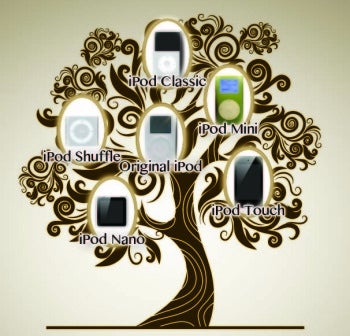
Originally, the now ubiquitous entertainment device was a 5GB music player that only worked with the Mac operating system and used a FireWire connection instead of a USB cable to update songs and charge the battery. After many iterations, today the iPod line includes the iPod Classic, the touchscreen iPod touch, the iPod Nano and the tiny iPod Shuffle.

The Evolution of the iPod [PICS]

Since its debut in 2001, the Apple iPod has evolved from the seminal white box with a mechanical scroll wheel to, ultimately, a sleek touchscreen multimedia device.
Over the years the various versions of the iPod have gotten smaller/larger and more colorful, they've lost buttons and gained them, have added cameras, speakers, radio, accelerometers and more. The only thing that hasn't changed appears to be the enduring popularity of the devices.
[More from Mashable: 3 FTC Cases That Could Affect Your Mobile App]
Join us on a look back through the last 10 years of the iPod. Let us know in the comments below which models you've owned -- and which were your favorites.
Thumbnail image courtesy of 37prime
[More from Mashable: 10 Seriously Addictive iPhone Strategy Games]
This story originally published on Mashable here.

Sabtu, 22 Oktober 2011

Happy 10th birthday to the iPod - the little machine that changed our lives

When the late Steve Jobs was handed the iPod prototype, he told his engineers it was too big. They said it was as small as it could be, that there was all kinds of technology to fit in that couldn’t be shrunk.
Apple’s chief executive paused and then, so the story goes, dropped the iPod in a fishtank. He pointed to the bubbles coming from the gadget and told the engineers that if there was air in it there was space in it. “Make it smaller,” he ordered.
The story is apocryphal but believable, given Jobs’s perfectionism. When Apple finally launched the iPod, 10 years ago this week, it changed how we listen to music, revolutionising the music industry and transforming Apple.

Let the music play and play: Steve Jobs and the first generation of the iPod - Happy 10th birthday to the iPod - the little machine that changed our lives
Let the music play and play: Steve Jobs and the first generation of the iPod
The iPod was not the first MP3 player but it was the first to get the technology so right it became a mass-market product. Rival machines were bigger and heavier or stored less music, took longer to transfer songs or had poor battery life. The iPod could store 1,000 songs, had a 10-hour battery life and enabled you to transfer lots of songs from your computer quickly. All of this in a device the size of a pack of cards.
Apple decided to build a music player in early 2001, and Steve Jobs asked Jon Rubinstein, head of hardware engineering, to look into it. In January that year Apple introduced iTunes, its music program for Macs. A month later, Rubinstein was shown a 1.8-inch hard drive during a visit to Toshiba in Japan.
“They said they didn’t know what to do with it. Maybe put it in a small notebook,” Rubinstein said later. “I went back to Steve and I said, 'I know how to do this.’ He said, 'Go for it.’”
The only drawback was time: Jobs wanted the iPod to be available that Christmas. A team of 30 began working long hours on Project P-68. Jonathan Ive, the British-born designer who has worked at Apple since 1992, said: “Like everyone else, I knocked myself out, not so much because it was a challenge – which it was – but because I wanted to have one.”
Ive oversaw every detail, but input came from across the team: the idea for the scroll-wheel control system came from Phil Schiller, Apple’s head of marketing; the name came from Vinnie Chieco, a freelance copywriter, who said the player reminded him of the escape pods on the spaceship in the film 2001. Underpinning it all were Jobs’s demands for simplicity and elegance. He stressed how important it was that any song could be reached in three clicks or fewer. “If ever there was a product that catalysed Apple’s reason for being, it’s this,” Jobs said after the iPod was released.
But the reaction was not wholly positive. At $399, it was too expensive, said critics; others thought the iPod lacked substance. At first, it worked only with Apple’s Mac computers, though in 2002, a Windows-compatible iPod was released. A year later came the iTunes Music Store and a Windows version of iTunes.
“That’s when it all started coming together. Sales of the iPod went through the roof,” says Feargal Sharkey, chief executive of UK Music, the body that represents the British music industry. Apple sold its millionth iPod in June 2003 and the two millionth six months later. At the end of 2004, it had sold 10 million.
By the middle of the decade, the white iPod earbuds were everywhere (ironically, they were the weakest feature). Apple’s adverts were everywhere, too – dancing silhouettes against bright backgrounds, clasping their iPods – and the message was clear: your music with you, all the time.
As sales grew, so did the iPod range: an iPod Mini, a screen-free Shuffle and the iPod Touch. To date, more than 300 million iPods have been bought.
Sales have started to fall, though, as more people carry their music on smartphones, which is why the iPod Touch is not just a music player but a games machine, web browser and communications device. Meanwhile, Apple, Google and Amazon have launched services that let you store music on internet “cloud” servers to be downloaded to whatever device you have. The iPod’s significance has waned but we haven’t lost that desire to carry our music with us.
“Ten years on, the most important thing is that it still has all my favourite tunes on it,” says Sharkey.

Apple iPod touch (2011)


http://www1.pcmag.com/media/images/322017-apple-ipod-touch-2011.jpg?thumb=yIn 2010, Apple's fourth-generation iPod touch got two cameras—one for shooting HD videos and photos, one for FaceTime chats. In 2011, the changes to the iPod touch are all based on the new iOS 5, which brings with it iMessage, iCloud, notifications, and Game Center enhancements. Physically, the player is unchanged, except now it's offered in white. The high-res Retina display remains crisp, colorful, and highly responsive to touch. Since the iPod nano ($129, 3 stars) no longer supports video, the 8GB touch is the least-expensive video-playing iPod, starting at $199 direct—a $30 price drop from 2010. The other two models remain $299 (32GB) and $399 (64GB). Despite the hefty price, the iPod touch is still, by far, the best portable media player you can buy—and it retains our Editors' Choice.
Design
There's a new white model, which is white on the front face and mirrored on the back, but the touch retains its 2010 dimensions: 4.4 by 2.3 by 0.3 inches (HWD) and 3.6 ounces. Apple's custom A4 chip powers the device, and the super-sharp Retina display remains 3.5 diagonal inches and 960-by-640 pixels (at 326 pixels per inch). The touch's left-hand panel houses two Volume buttons. A headphone jack, a speaker, and a 30-pin connector for USB computer syncing are on the bottom of the player. The Power button sits up top, and the Home button remains below the display on the front panel. There are two camera lenses—one toward the top of the display, and one on the back, in the top left corner, which is accompanied by a mic. The mirrored back panel is excellent for checking your teeth on the sly, but it picks up fingerprints very easily.

Specifications

Storage Capacity (as Tested)
32 GB
Player Type
Portable Media Player
Radio
Optional
Music Playback Formats
AAC, AIFF, Apple Lossless, Audible, MP3, WAV, Protected AAC
Photo Formats
BMP, JPEG, TIFF, PSD, PNG, GIF
Video Formats
MPEG4, H.264
Audio Battery Life
47 hours 25 min
Dimensions
4.4 x 2.3 x 0.3 inches
Weight
3.5 oz
More
In the box, you'll find a Quick Start Guide, a proprietary USB cable for connecting the touch to your computer, and a pair of Apple signature earbuds. It's a good idea to upgrade those bass-deprived, ill-fitting earbuds to earphones, and our Ultimate Guide to Headphones is a good place to start your search for the right pair.
User Interface
With the inclusion of iOS 5, the iPod touch now becomes a messaging device. It can also use the new iCloud function, which features iTunes in the Cloud, Photo Stream, and Documents in the Cloud, so you can share content wirelessly between your computer, your iPod touch, your iPhone, and your iPad. Another useful new feature is Notifications, which works with just about any relevant app to keep you informed about updates and friends' responses. For more about what iOS 5 can do, check out PCMag's full review, or read on here to discover some of the nuances that improve the iPod touch's performance.
Audio and Video
Navigating the music menus on the iPod touch is completely intuitive. First off, there are so many ways to do it—using CoverFlow, searching Artist or Song, or perusing playlists. Apple has made everything fast and easy—scroll song or artist lists by dragging a finger or skip ahead to a letter on the scrollable alphabet on the right side of the screen. The Now Playing view is a showcase for album art, and you can play music while you surf the Web, view photos, or even play games.
By itself, the iPod touch is a fine audio device—plug in a pair of good-quality headphones and you won't be disappointed with the frequency range and overall audio quality. To my continuing disappointment, Apple still offers its stock, subpar earbuds. Audiophiles listening to Lossless tracks on the touch will be best served by leaving the EQ off. The settings Apple provides are presets; there's still no user-customizable EQ. Extra features like Shake to Shuffle, Volume Limit, and Sound Check can all be enabled or disabled easily.
The iTunes Store can be accessed via Wi-Fi for on-the-spot music and video purchases. Video looks fantastic on the Retina display. YouTube and Netflix will not look as sharp as video purchased from the iTunes Store, of course, but the speed with which video can be cued up without stuttering is impressive. Again, this is dependent on the strength of your Wi-Fi signal.
The touch integrates Bluetooth 2.1 + EDR and 802.11b/g/n Wi-Fi, though 802.11n only operates on the 2.4GHz band. Nike+ iPod support is also included for those who want to use the touch to help keep in shape.
CameraThe rear-facing camera records video in HD (720p), up to 30fps, capturing audio through the rear panel mic. Still photos max out at 960 by 720 pixels. This amounts to less than a megapixel, and compared with the iPhone 4S ($199.99-$399.99, 4.5 stars) and its 8-megapixel rear camera, the quality in images is stark. (See the slideshow for a side-by-side comparison.) The front-facing camera, intended for FaceTime video chat, offers lower resolutions: VGA-quality for photos and videos, again, up to 30fps.
Camera operation couldn't be more intuitive. An onscreen slide control toggles between still and video camera modes, and an icon in the lower left takes you to your gallery, where you can peruse your photos and videos. Video footage plays back onscreen with a scroll tool that shows a thumbnail timeline of your footage, making skipping to a certain spot easy. You can trim your footage on the player by dragging your finder over the thumbnail timeline of the footage and selecting segments to cut.
Capturing video is achieved by pressing the red Record button onscreen when in video camera mode, and tapping it again to end recording. The screen acts as your viewfinder and everything moves along in real time without stuttering. Low-light situations will make for some noisy footage, but in well-lit scenarios, the touch's video looks colorful and crisp. Uploading your video to YouTube or sending it as an email attachment, provided you have a Wi-Fi connection, is made easy with a button in the lower left-hand corner of the screen that walks you through a streamlined process to do either.
Unlike the iPhone 4S's camera, the iPod touch's has no flash, which makes low-light—particularly back-lit—scenarios rather challenging. You get 5x digital zoom for photos, which is activated by moving the slider on the screen above the on-screen shutter button, but zooming in creates noticeable artifacts. Landscape shots in adequate lighting look decent for a camera built into a player, and well-lit portraits look sharper than you'd expect, provided you don't zoom in too far. Like videos, photos can be sent out immediately via email, or you can assign a photo to be your new wallpaper or a friend's contact photo, all by pressing the lower left-hand button when viewing your image.
iMessage and FaceTime
iOS 5 brings iMessage to the iPod touch. If you use an iPhone, the difference between an iMessage and a text message is pretty much undetectable—they appear the same in your Messages app. However, iMessage uses Wi-Fi rather than a carrier's signal, which means that Wi-Fi devices, like the iPod touch, are invited to the party. Not invited: Devices not running iOS 5. Still, any friends of yours with an iPhone, iPod touch, or iPad can now be sent virtual texts via iMessage—all you need is a wireless signal. This means you can send them photo and video straight from your iPod touch, too.
FaceTime still works quite well—images are fairly crisp and clear, aided by the smaller screen, and it's easy to understand what your chat partner is saying. Of course, this is contingent on your Wi-Fi signal being strong, but in ideal scenarios, it's not much different than video chatting on a laptop. However, Google Talk has a bit of an advantage over FaceTime, in that it works across multiple operating systems. You can, for instance, chat on Google Talk between a Motorola Xoom ($599, 3.5 stars) and an Apple laptop; FaceTime, like iMessage, only works between iOS devices and some Apple computers. But what began as a portable media player with no camera now has video chat and virtual text messaging capabilities—even with its iOS 5-only limitations, that is quite impressive.
Gaming and AppsIn 2010, Apple introduced Game Center, a feature that encourages you to find a friend—either someone you know or a stranger with an iPod touch or an iPhone—to play real-time games. Your success (or failure) earns you a ranking you can use for bragging rights or to seek out opponents with similar skill levels. With iOS 5, Game Center gets a few new features, like the ability to purchase new games from within the app and add photos to your profile.
Meanwhile, the App Store, which is accessed via Wi-Fi, is loaded with single-player, accelerometer-driven games like Zombie Highway, that look fantastic on the Retina display. There are more than 500,000 apps with a range far too wide to detail here. If you're familiar with the iPhone or iPod touches past, you know the possibilities are endless.
Web, Email, and Notifications
Surfing in Safari on the iPod touch is a great experience.  Now that the Zune HD (4.5 stars), which was also a strong Internet device, is officially a relic, the iPod touch offers the strongest Web experience on any device this size that isn't a mobile phone. Still, there are some annoyances. Given Apple's stance on Flash support, you shouldn't expect it on any iPod or iPhone anytime soon, and that's the single advantage competing mobile browsers can offer.
Email remains easy to customize and use—AOL, Gmail, Yahoo Mail, Microsoft Exchange, and mobileMe remain options in the mail section, where you can also add an iCloud account. Multiple accounts can be synced via Exchange.
With the new notifications features in iOS 5, email notifications appear on-screen, as well as app notifications—say, when your opponent makes a new play or a friend comments on your Facebook post. Notifications appear on the Lock screen (Alerts), at the top of the home screen (Banners), just over the app's icon (Badges), and you can choose between various combinations of the three for each app—or to turn them off completely.
Battery Life and Conclusions
Apple rates the battery life for the iPod touch at an impressive 40 hours for audio and seven hours for video. We ran three different battery rundown tests. With Wi-Fi on, and the screen illuminated (meaning Auto-Lock is disabled) and audio playing, we got a reasonable four hours and 25 minutes. With Wi-Fi off and the screen going dark (Auto-Lock set to one minute), we got a great result: 47 hours and 25 minutes. For video playback with the screen brightness at maximum and with no Wi-Fi on, we got one hour and 41 minutes—not enough time to watch a full movie, in most cases.
There are very few devices left that you can actually compare directly with the iPod touch, though both Sony and Samsung have announced, but not yet shipped Android-based PMPs. Many manufacturers have thrown in the towel and are taking on slightly less daunting targets, like the iPod nano or the iPod shuffle ($49, 3.5 stars), or are focusing on tablets instead. The only real problem with the touch is its high price—especially if you want a decent amount of storage. But with an entry point of $199, you do get a camera, HD video recording, messaging and video chat, a music and video player, portable gaming, the Web, email, and apps all in one slick, pocket-size package. It was true when it first debuted, and even more so now: No other portable media player can compete with the iPod touch.

Minggu, 09 Oktober 2011

Apple iPod touch

Apple iPod touch : Apple announce great new features and a more affordable price for the Apple iPod touch. The Apple iPod touch will be available in new black and white models starting at just $199, including Apple’s new iOS 5 and iCloud services. Apple iPod touch is the best selling iPod ever, and with iOS 5 and iCloud it is better than ever. The new Apple iPod touch includes iOS 5, the world’s most advanced mobile operating system, which includes over 200 new features including iMessage, Game Center, Notifications and Wi-Fi Syncing to iTunes. iMessage brings the functionality of iPhone messaging to your Apple iPod touch, so you can easily send text messages, photos, videos and contact information to an individual or group on other

Apple iPod touch

Apple iPod touch works with iCloud
Apple iPod touch also works with iCloud, Apple’s breakthrough set of free cloud services, including iTunes in the Cloud, Photo Stream and Documents in the Cloud, that work seamlessly with your iPhone, iPad, iPod touch, Mac or PC to automatically and wirelessly store your content and push it to your devices. When content changes on one device, all your other Apple devices are updated automatically and wirelessly.

Apple iPod touch Apps

App Store on the Apple iPod touch
With the App Store on the Apple iPod touch, users have access to the world’s largest and best collection of over 500,000 apps, including over 100,000 game and entertainment titles. Customers also have the iTunes Store at their fingertips, giving them instant access to the world’s largest catalog of over 20 million songs, 85,000 TV shows and 14,000 movies to purchase and download directly to their Apple iPod touch.

Apple iPod touch price

Apple iPod touch price
Apple iPod touch with iOS 5 and iCloud will be available October 12 in black and white for a suggested price of :
• Apple iPod touch 8GB model : $199 (US)
• Apple iPod touch 32GB model : $299 (US)
• Apple iPod touch 64GB model : $399 (US)

Apple iPod touch video

Apple iPod touch compatibility
Apple iPod touch requires a Mac with a USB 2.0 port, Mac OS X v10.5.8 or later and iTunes 10 or later; or a Windows PC with a USB 2.0 port and Windows Vista or Windows XP Home or Professional (Service Pack 3) or later and iTunes 10.5 or later. Apple iOS 5 will also be available as a free software update for Apple iPod touch (third and fourth generations) customers allowing them to experience the amazing new features including iMessage, Game Center, Notifications and Wi-Fi Syncing to iTunes.

iPod touch Apple

Apple iPod prices
Apple iPod is the world’s most popular family of music players. Apple’s holiday lineup includes iPod shuffle for just $49; iPod nano with Multi-Touch starting at just $129; iPod touch available in black or white, including iOS 5 and iCloud, starting at just $199; and iPod classic in a 160GB model for $249.

Apple iPod

Rabu, 05 Oktober 2011

Apple inventory adds two new iPhones, three new iPod touch devices


Apple’s iPhone 5 unveiling called “Lets talk iPhone” is scheduled for October 4, and leading up to the major event is of course more speculation and clues as to what the company may have in store for everyone. According to a inside tip, Apple has updated its internal inventory system to include two new models of the iPhone and three new models of the iPod touch.


The two new models listed in the system for the iPhone don’t seem to include the iPhone 5. Instead, they are likely the white and black versions of a slightly updated iPhone 4, possibly iPhone 4S, with the codename N90A. The iPhone 4 has the codename N90, whereas the iPhone 5 has been referenced to in the past as the N94, which hasn’t shown up in the system yet.
The new iPod touch models have shown up with the codename N81A, also suggesting a minor step up from the previous generation model, which had a codename of N81. The three models could be for the different storage capacities of 8GB, 32GB, and 64GB. We’ll find out for sure when we attend Apple’s “Let’s talk iPhone” event next Tuesday, October 4, so stay tuned for our live blog.

iPod Touch an Indispensable Tool in My Life

To salute Steve Jobs' imprint on the technological world, Yahoo! News asked readers and contributors to briefly write about their favorite Apple device or technology. To share yours, sign up with the Yahoo! Contributor Network.
Over the years, I have owned many Apple products but my favorite is still the iPod Touch. I use mine every day. It goes everywhere with me.
My iPod Touch was $399 when I bought it brand new in the 64GB storage version as a birthday present to myself. Usually I feel guilty spending so much on myself but I wanted one for so long and for so many different uses. It was much more than an MP3 player -- like previous versions of the iPod my kids and I had owned.
I use it every day for taking pictures and sharing them on social media sites, updating Facebook, Twitter and other social media, following news headlines, managing my calendar and alerts, scrolling news headlines for my job and even writing notes or draft articles.
It has become an indispensable tool in my life.

Minggu, 02 Oktober 2011

iPod touch 5G features chosen by you

You wouldn’t think there would be a new iPod touch 5G at the Apple event in two days, especially considering Apple named the invites with “iPhone” and not “iPod”. So we know for sure they want to talk about the iPhone 5/4S, but what about other products and services like iCloud, and a new iPod device?
We spoke about rumors of a new touchscreen home key back in April of this year, and the possibility of a white 5th generation iPod touch appearing at Tuesday’s press conference with just a few changes, although is this what the users want? We looked at the feedback from PR readers and it seems most of you would like an upgrade and have voiced your opinions on what iPod Touch 5G features are needed.
Some of you made a few predictions for the next iPod, which include the device being smaller this year and featuring an A5 processor with increased RAM, and 1080p video recording. One of the most wanted features is “3G”, although some people quickly point out this will help Apple lose sales of the iPhone.
So no matter how crazy some of the wanted features are, these are the ones you asked for so far: 3G Internet, a larger display, 8PM camera, a faster processor, 4G, ability to make free phone calls, free Internet access, a cheaper price, FM radio like on the Nano, and more battery life when using video. It seems that a lot of people want all that they expect on the iPhone 5, but without the phone.
When do you think Apple will release the iPod touch 5G? And are any features missing from what’s mentioned above, which you want?

Sabtu, 01 Oktober 2011

Banned iPod app finds new home on Android

http://admintell.napco.com/ee/images/uploads/gadgetell/phonestory.pngA game the developers call educational but that Apple’s App Store considered controversial enough to ban has found a new home on Android. “Phone Story” is a game that takes place at an foreign electronics plant. The player supervises workers whose job it is to put together smartphones in sweatshop like conditions. Child labor is depicted and a mini-game called “Suicides” is included. In it you have to stop as many workers as possible from killing themselves. So many iPhone users reported it that Apple investigated and banned it. The reasons given were that it was crude, depicted child abuse, and was meant to raise funds for charitable causes. Obviously they must have also been upset at the fact the game depicts the very real issues at their Foxconn plant in China
This didn’t deter the developers. They wore their ban with pride and simply moved the game to the Android platform, where it has been selling briskly for $1. (It’s also still available for jailbroken iPhones and iPod Touches) The developers, who appear to be from Italy, say they only want to raise awareness of the human and ecological abuses that come with smartphone manufacturers and raise funds for organizations dedicated to improving those conditions. Will you buy the app? Why or why not?

iPod classic and iPod Shuffle to be discontinued?


How is one suppose to maintain his or her relevance in society? Well, by keeping up with the times, of course, and the same can be said for companies as well as products that roll through their doors. The iPod classic and iPod Shuffle seem to have been around for forever now, where the former carries a small hard drive inside while the latter lacks a display which has long proved to be a bitter pill to swallow although you can’t argue with its price.
It seems that Apple has had enough of both devices, knowing that touchscreen devices are the way to go, so sentimentalism is definitely out of the question if Apple were to remain competitive. After all, why bother when sales of both devices have been on the decline for some time already?
Interestingly enough, the iPod classic has been hanging around the gadget scene for a decade already, making me wonder just where the time had gone. Could this mean the death of clickwheel applications in the future?
Source

Related Posts Plugin for WordPress, Blogger...

 
Design by Free WordPress Themes | Bloggerized by Lasantha - Premium Blogger Themes | cheap international calls